When we spend decades of our life operating from our original wound, we repeat the same dreadful patterns because we are avoiding the actual steps it takes to heal that wound.
Operating from the wound looks like people pleasing, giving too much, expecting too much, trying to chase love, loving the wrong people, and codependency, to name some of the common behaviors we engage in to try to patch the wound for a moment. Yet putting bandaids on a huge open wound only makes the situation worse.
When we have an open, unhealed wound, we make ourselves a target for the types of people who can easily see our vulnerability and take advantage of it. Those types of people often have huge, gaping wounds of their own and are trying to use us as their bandaids. This can wrap us into a cycle of constant disappointment when we realize that a relationship did not heal the wound at all.
Relationships don’t heal wounds; they rip the bandaids off. They tear down the armor we put up around our hearts so that we can understand the wound is there, and unless we heal it, having a healthy relationship is challenging. This is why so many relationships fail, and why family relationships can be so dysfunctional and frustrating.
Wounds are most often created by family. It’s an unfortunate factor in being human. We do tend to hurt the people closest to us, and immediate family is as close as it gets. The household we were raised in and the people around us at that time are major influences in creating our perception of the world and our trust in it.
The original wound that gets pried open even more every time we are emotionally hurt by another person most often comes from our upbringing. That’s a hard thing to see at first. We can be mad at the adults all we want, but the most difficult part is seeing that we are operating from a wound. When we are young—the angry teenager—we can’t see that in ourselves. Our anger feels justified even if we never really look at why we are actually angry. Within a family, this can be carried on forever.
The wound operates in friendships as well. We tend to think of love relationships that have gone wrong and feel those fallouts deeply. But friendships are areas where wounds exchange so much more than just conversations. Within the wounded friend is the potential for jealousy, competition, and thoughts that are not spoken. Thoughts carry energy, so in friendships there’s often a discordant energy if one or both people are operating from a wound.
Operating from the wound is ultimately destructive to relationships when we are acting out a role that allows us to play out scenarios that seem like opportunities to heal the wound or resolve major life issues. We throw our emotional pain around, unknowingly affecting everyone around us. Even the most compassionate, empathetic people can do this.
Granted, we will have some people who share with us in a way that is healing. We will have relationships that are healthy. It’s the repeating patterns where we are left emotionally torn apart that tell us it’s time to heal.
The healing is what is painful.
This is because it requires us to stop, spend time alone, and go within to where the wound is radiating and where it hurts the most. Some people spend a lifetime building a wall around the open wound, preventing it from ever being touched or healed. The wound needs to be tended to properly. It needs care. It needs to be seen.
Essentially, the wound needs us. We have to return to ourselves and care for ourselves in order to heal. This often requires stepping away from society for a bit. It means remembering correctly what originally brought us to this place of grief and pain. It sometimes requires honest conversations with others. It sometimes requires no conversations with certain people.
To heal, we must look at ourselves from an honest perspective, and that’s where healing can be painful. We can see our mistakes and often we feel ashamed. That’s okay; it’s part of the process. One thing the healing phase does is humble us. If we’ve been operating from a wound our whole life, we may have felt justified while at the same time putting a lot of pressure on others who didn’t understand our perspectives. We feel misunderstood.
To heal, we can’t really go to others and make them responsible for our wound or engage them in its healing. This is where it can be especially painful. We are used to our relationships being the bandaids, and we are used to convincing ourselves this will work this time. This is our pattern—to involve others in the wound, to act out a story of healing within a relationship with another. To heal, we must put the focus on ourselves and the steps we alone will take.
Once we start on the journey of healing, it’s very easy to find ourselves going right back to old habits to avoid the emotional pain. We can numb out with food, alcohol, substances, or by excessively running ourselves ragged and doing way too much. It’s hard to sit in solitude. It’s uncomfortable to really face ourselves. It’s hard to consider where we behaved badly, even if our intentions were innocent.
Healing brings about the original pain and all the pain that happened throughout the decades, but it also brings a light feeling of peace and release when we stick with it. Initially, we feel somewhat horrified when we really see our wound. It’s like, “Wow! How could I have gone so long without seeing this?” Then we start to commit to being there for ourselves. We commit to staying with the discomfort. And once we start to feel our true selves coming back to us, it can be an emotional release.
Living for ourselves again can feel scary.
Once we start to live for ourselves again, we may feel a flood of emotion that swells in us, and that feels vulnerable. Sometimes when this happens, we want to contract and pull back in order to put up our personal armor so that we won’t be navigating the world without it. We start being more protective of the wound than operating from it. So letting our guard down and enjoying life can feel scary.
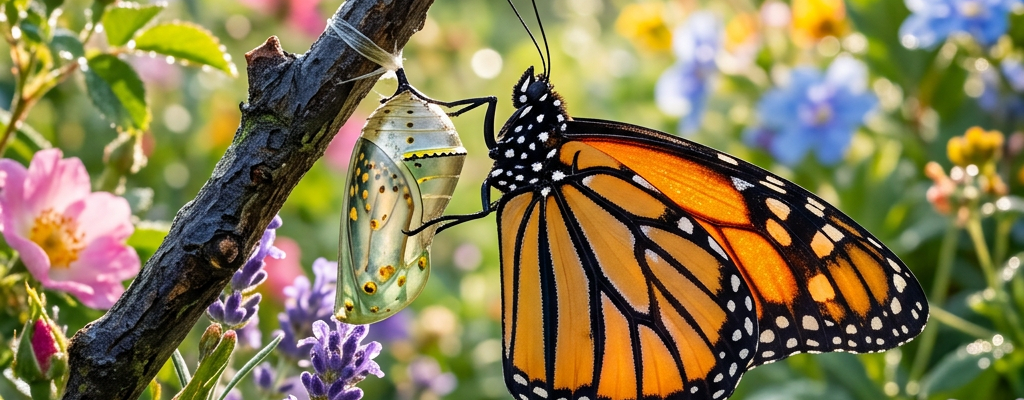
Yet, once we really emerge from the chrysalis, we will feel the freedom to be ourselves and to love who and what we are. Each of us is a beautiful soul, reemerging as the healed version of ourselves that operates from that beautiful soul. When we operated from the wound, our true soul got buried underneath the version of ourselves that behaves with the intention of fixing the other, or being enmeshed, codependent, or avoidant. This is what causes us to feel uneasy, like something is off, and can even affect our well-being.
When the transformation is complete, the feeling of sweet freedom can be exhilarating. We return to ourselves, free to allow ourselves to be who we truly are in this lifetime. We shine our own light in our own personal and unique way. Once we start operating from our genuine self, we find the confidence to handle the difficult things in life more effectively. We start to attract healthy relationships and readjust our boundaries around relationships that have not been healthy for us.
Sometimes that level of deep healing can cause the end of bad relationships, leading us to believe we will never be free of emotional pain and grief. Yet these things are simply part of being human. We cannot avoid loss in our lives. People will pass away, and people can leave for all kinds of reasons. We have to be okay and not react from the wound. We have to be okay if someone does not choose us.
Sometimes we might fall back into our old self for a moment and find ourselves reacting in a way that is very personal and painful. That’s okay too. We can catch ourselves in these moments and return to ourselves in the same way we learned to take care of ourselves when we went within and spent the time to heal. We will never be perfect, and neither will anyone else. That’s an important thing to keep in mind.
Nobody is perfect.
In our healed state, we need not expect people to act and react in ways that we approve of. We have to understand that each person comes with flaws and most with their own wounds. Once we are healed, we can see people reacting from their own wounds and separate ourselves from that by being aware and knowing that their stuff is theirs. We can’t take on the job of fixing others. It’s simply not our job, nor does it work. Trying to fix someone else can hurt them more than help them.
Healing teaches us healthy boundaries and helps us avoid breaking boundaries ourselves. We have to allow others to face their own pain and deal with what the healing process looks like for them. Healing helps us be strong when another person is blaming us for their wounds or projecting onto us their misdirected anger and deepest regrets. Once we know ourselves, we can see clearly the things that no longer serve us. Even if painful at first, this process is worth it.
Healing brings with it the ability to have better relationships and to work within difficult relationships without reacting in a destructive or stressful way. Our confidence becomes key here. Once we heal our wound, it means we looked at it, and in the humility it takes to do that, we also shed the weight of past regrets. We become capable of moving forward and not using our past as familiar ground.
When we do move forward, we know that we did this on our own. We were strong enough to get ourselves past the trauma of past experiences and came out of it wiser and more humble at the same time. We might feel like a sage or a knight who holds that wisdom close to our hearts, in a way that speaks silently to others that we do, in fact, have the strength and confidence to handle whatever circumstances life throws at us.
We should not expect healing to mean we will never have hard times or be disappointed or hurt. We can’t avoid the things that go along with experiencing life. There’s no magic solution to problems that arise during our time here on Earth. Difficulties arise, and we may experience or witness something traumatic even after we heal our original wound. The difference is that we won’t overreact from that old wound, and we can operate from a place of stability rather than from a space of hypervigilance or fear.
We are all capable of returning to our true selves and cherishing the wisdom we have gained by getting ourselves through the healing, emerging as the beautiful butterfly who gets to unabashedly enjoy the freedom of flight while adding to the vibrant beauty of this planet.
Healing can be a painful, positive endeavor. It’s worth every moment spent on it. The benefits are enormous and empowering, and can lead to a better way to experience life and love.

