By: Cristina Manos RPh. (www.BeCalmYogaStudio.com)
What is a PBM you ask? Well, let me explain it to you and the rest of the Western world.
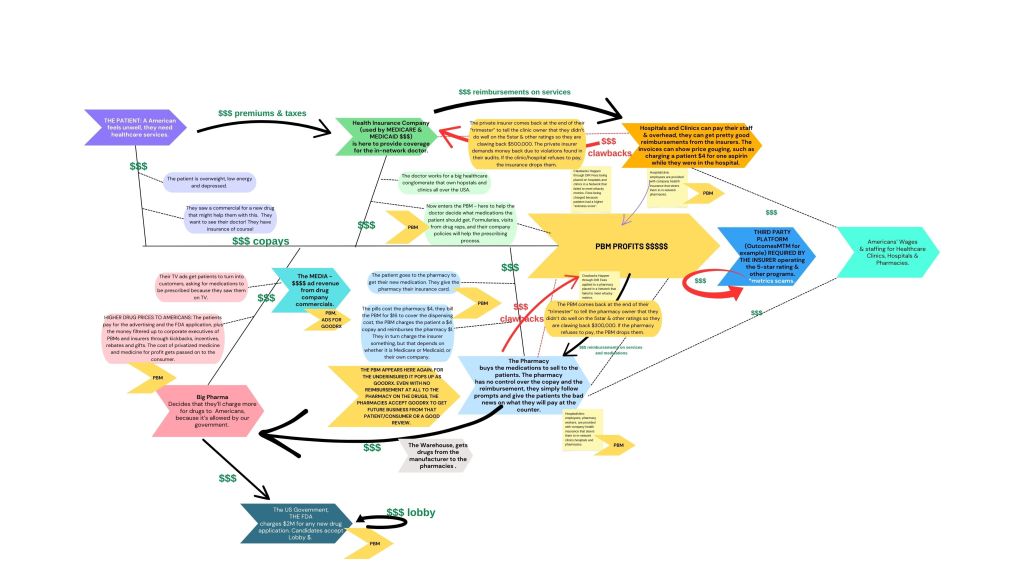
As we have health insurance companies like United Healthcare, we also now have an extra player on the field. We have prescription drug insurance companies, Prescription Benefits Managers (PBMs). PBMs are unnecessary companies that partner with insurance companies. They then control pharmacy coverage for medications prescribed to you by your doctor. Your doctor bills United Healthcare for the visit and your pharmacy bills their partnering PBM for your medications.
If you have an insurance card, it may say United Healthcare on it. However, you may see another emblem on the card, like Caremark or OptumRx, for example. There will be extra numbers on that card, like the BIN number, a six-digit code that links to the PBM. The pharmacy bills the PBM for your prescription medication, and the PBM determines the copay the pharmacy charges you.
The PBM is said to save insurers time and money, as PBMs take over the job of negotiating with drug companies for savings. In addition, they negotiate with the pharmacies themselves about reimbursing them for the drugs they dispense to the public. These are where the biggest money grabs happen. It’s not just by way of rebates and kickbacks.
What did insurers and pharmacies have before PBMs? They simply had a “fee for service” deal in place, and that’s exactly what we should return to. There was a fee for service attached to every prescription filled to cover labor and overhead. For instance, if the pharmacy charged you $1 for 100 pills, your insurance company and copay would cover that $1 and pay the service fee of $2.50. The pharmacy then received $3.50 for that transaction.
You tell me, the richest man in the world – Why are drugs so much cheaper in Canada and across Europe than in the United States?
Me thinks it is because of corporate greed. And they don’t use PBMs. These places also have very reasonable regulations on capitalism in healthcare. They also understand that basic life services like clean water, emergency responders and medicine are social services. This is because everyone has the right to a healthy life. Drug companies profit from drugs purchased by the rest of the world.
We, here in the United States, can’t even afford our healthcare insurance let alone the cost of our drugs. Getting sick bankrupts most of us. Private insurers, Big Pharma and WalMart are the target of our ire, and rightfully so.
PBMs exist only to make money for PBMs. They are a very destructive part of our healthcare system because they skim off the top of the healthcare environment.
The governor of California, Gavin Newsome, refused to put into California law that PBMs need to be licensed and regulated, because he claimed that he could not see a “granular” reason for this. “He also rejected a hotly contested measure by Democratic Assemblyman Jim Wood of Ukiah that would have given the state more power to block the sale of health care companies to for-profit investors, such as hedge funds and private equity firms.” It’s just one example of why we can’t get anything done in healthcare in the United States – how much more granular can it be that an Epipen costs $60-$145 in Canada and across Europe, but costs between $400-$600 in the United States of America?
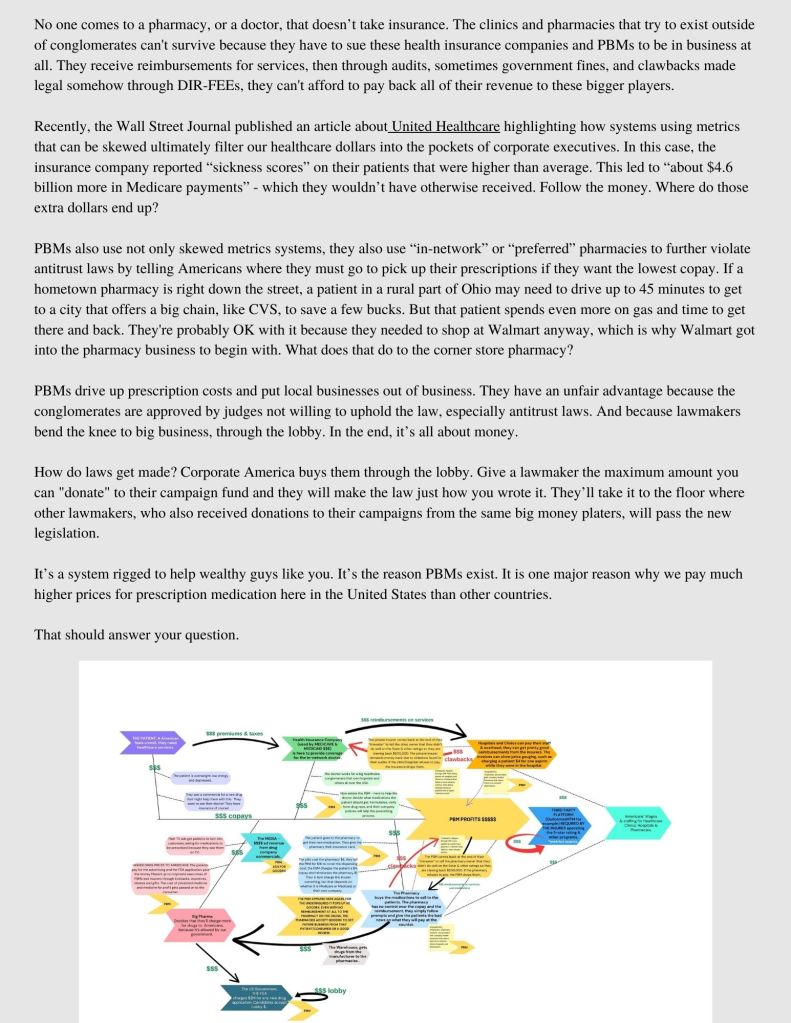
I’ve created a money flow chart to make it easier for you, and Gavin Newsome, to understand what a PBM is. I’ve also explained how it functions in the picture of health insurance. Yet, there are intricate scams going on within health insurers’ policies and programs. These scams funnel money from premiums, and tax-payers’ contributions, to corporate executives. These scams can be learned about by asking the experts in the field – the pharmacists and the healthcare professionals that are forced to work in a system that we know is a mess. Ask us. Sit with us. Talk to us. WE will tell you.
There are only 330,000 practicing pharmacists in the United States. We are a very small percentage of the actual workforce and our numbers mean we’ve largely been silenced by corporations that employ a much larger percentage of the population, and who basically rule stronger than our actual local and federal governments. I call it corporate fascism. And it’s one of the reasons DEI programs were a complete waste of time – discrimination of all kinds is rampant in the workplace and professionals like pharmacists are considered and treated as overcompensated employees.
PBMs for us are just another example of businessmen, who don’t care about anyone’s health but their wallets, jumping onto the scene to get a piece of the pharmaceutical pie. Why should Big Pharma have all the fun and suck up all the profits? PBMs don’t make drugs cheaper. The PBMs simply take some of the profits and shift them into their direction. This makes lowering drug prices and having fair competition for business owners, almost impossible.
Like Jeff Bezos, Amazon is now your pharmacy. The government consistently allows such conglomerates to exist, and some become monopolies. Even worse is CVS/Caremark, who has been allowed to merge with Aetna so that one company is your (1) doctor through their minute clinics and now primary care clinics; they are your (2) health insurance company, as they merged with Aetna; they are also the (3) PBM Caremark, who is one of the Big 3; and they are of course, (4) your “referred” pharmacy – there to collect your copay and overwork an understaffed pharmacist until they want to commit suicide, or they just have a heart attack and die at work. That happened.
I can also explain the intricate scam of clawbacks, which put independent doctors and pharmacists, who wanted to own their own practices and pharmacies, out of business. This is done through DIR-fees, and through the biggest conspiracy scam in healthcare that includes Medicare and Medicaid, called the 5-Star Rating. It is a really wacky system that uses impossible network metrics to force labor onto doctors and pharmacies. This is in order for them to think they’re receiving reimbursement for services, to all but force the patients to start taking very specific drugs. And what they are actually doing is wasting labor hours on a scam that will lead to huge clawbacks of reimbursements by insurers/PBMs – and in turn, their local employer failing to turn profits and stay in business.
No one comes to a pharmacy, or a doctor, that doesn’t take insurance. The clinics and pharmacies that try to exist outside of conglomerates can’t survive because they have to sue these health insurance companies and PBMs to be in business at all. They receive reimbursements for services, then through audits, sometimes government fines, and clawbacks made legal somehow through DIR-FEEs, they can’t afford to pay back all of their revenue to these bigger players.
Recently, the Wall Street Journal published an article about United Healthcare highlighting how systems using metrics that can be skewed ultimately filter our healthcare dollars into the pockets of corporate executives. In this case, the insurance company reported “sickness scores” on their patients that were higher than average. This led to “about $4.6 billion more in Medicare payments” – which they wouldn’t have otherwise received. Follow the money. Where do those extra dollars end up?
PBMs also use not only skewed metrics systems, they also use “in-network” or “preferred” pharmacies to further violate antitrust laws by telling Americans where they must go to pick up their prescriptions if they want the lowest copay. If a hometown pharmacy is right down the street, a patient in a rural part of Ohio may need to drive up to 45 minutes to get to a city that offers a big chain, like CVS, to save a few bucks. But that patient spends even more on gas and time to get there and back. They’re probably OK with it because they needed to shop at Walmart anyway, which is why Walmart got into the pharmacy business to begin with. What does that do to the corner store pharmacy?
PBMs drive up prescription costs and put local businesses out of business. They have an unfair advantage because the conglomerates are approved by judges not willing to uphold the law, especially antitrust laws. And because lawmakers bend the knee to big business, through the lobby. In the end, it’s all about money.
How do laws get made? Corporate America buys them through the lobby. Give a lawmaker the maximum amount you can “donate” to their campaign fund and they will make the law just how you wrote it. They’ll take it to the floor where other lawmakers, who also received donations to their campaigns from the same big money platers, will pass the new legislation.
It’s a system rigged to help wealthy guys like you. It’s the reason PBMs exist. It is one major reason why we pay much higher prices for prescription medication here in the United States than other countries.
That should answer your question.
 becalmyogastudio.com